
Blog, T-Shirt Guides
Political T-Shirts: How a Simple Tee Became the Most Powerful Protest Tool in History
Mar
A Simple T-Shirt Just Made International Headlines — Again
In March 2026, an 18-year-old woman in Brisbane, Australia was arrested for wearing a tank top with a political slogan at a protest. The charge? Violating Queensland’s new hate speech laws. The potential penalty? Up to two years in jail. The story exploded across social media, racking up over 767,000 views on X (formerly Twitter) in just hours.
Whether you agree or disagree with the arrest, one thing is undeniable: a t-shirt started a global conversation. And this isn’t the first time.
For nearly a century, the humble t-shirt has served as a powerful vehicle for protest, self-expression, and political identity. From anti-war slogans in the 1960s to viral meme shirts in the 2020s, what you wear on your chest has never been “just fashion.” It’s a billboard. A manifesto. Sometimes, apparently, even a criminal offense.
In this deep dive, we explore the fascinating history of political message t-shirts, the landmark moments that turned cotton into controversy, and why the protest tee remains one of the most powerful communication tools ever created.
The Birth of the Political T-Shirt: 1948
Before t-shirts became canvases for rebellion, they were underwear. Literally. Issued as standard-issue undershirts for U.S. Navy soldiers in World War II, t-shirts weren’t designed to be seen — let alone read.
That changed in 1948 when the first known political t-shirt was created for Republican presidential candidate Thomas E. Dewey. The shirt read “Dew It With Dewey” — a clever pun that marked the very first time a t-shirt was used as a political campaign tool. Dewey lost the election, but the concept was born: clothing could carry a message.
Still, the t-shirt remained mostly hidden under shirts and jackets throughout the late 1940s and early 1950s. It would take Hollywood rebels to bring it into the spotlight.
The 1950s: Marlon Brando, James Dean, and the T-Shirt as Rebellion
Two movies changed everything. Marlon Brando in A Streetcar Named Desire (1951) and James Dean in Rebel Without a Cause (1955) both wore plain white t-shirts on screen — not as undergarments, but as outerwear. The effect was electric.
Suddenly, the t-shirt wasn’t just comfortable — it was defiant. It signaled youth, masculinity, and a refusal to conform to the buttoned-up fashion norms of postwar America. While these early shirts didn’t carry printed messages, they established the t-shirt’s identity as a garment of rebellion and individual expression.
This cultural shift set the stage for what was about to happen in the most turbulent decade of the 20th century.
The 1960s: T-Shirts Become Protest Billboards
The 1960s were a powder keg — the Vietnam War, the Civil Rights Movement, the counterculture revolution. And for the first time, screen printing technology made it affordable to mass-produce printed t-shirts.
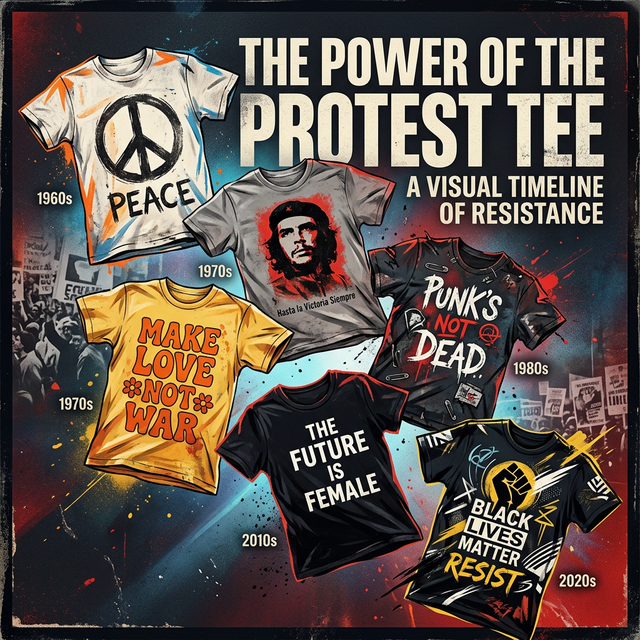
Activists seized the opportunity. Anti-war protesters wore shirts reading “Make Love, Not War.” Civil rights marchers printed messages of equality and justice. The t-shirt transformed from fashion item to walking protest sign — a sign you couldn’t put down, couldn’t confiscate, and couldn’t ignore.
Key moments from this era:
- “I Am a Man” — worn by striking sanitation workers in Memphis, 1968, during the movement that brought Martin Luther King Jr. to the city
- Peace symbol tees — the iconic CND (Campaign for Nuclear Disarmament) symbol became one of the most reproduced graphics in t-shirt history
- Che Guevara portrait — based on Alberto Korda’s 1960 photograph, this became arguably the most famous political t-shirt image of all time
The message was clear: you don’t need a platform to have a voice — you just need a t-shirt.
The 1970s-80s: Punk, Politics, and Katharine Hamnett
The punk movement of the late 1970s weaponized fashion. Designers like Vivienne Westwood and Malcolm McLaren turned ripped, safety-pinned t-shirts with anarchist slogans into badges of cultural defiance. The Sex Pistols’ iconic “God Save the Queen” shirt remains one of the most recognizable political garments ever made.
But it was British designer Katharine Hamnett who elevated the political t-shirt to high fashion. In 1984, she met Prime Minister Margaret Thatcher while wearing an oversized white tee that read “58% Don’t Want Pershing” — a reference to American nuclear missiles stationed in Europe. The photo became a global sensation.
Hamnett described her slogan tees as “billboards aligning you with a group of people saying ‘This is who I am.'” She proved that a t-shirt could be simultaneously a fashion statement and a political weapon — no microphone required.
The 2000s-2010s: Social Media Amplifies the Message
The internet — and later, social media — gave political t-shirts an entirely new dimension. A shirt worn at a protest could now be photographed, shared, and go viral within minutes. The message wasn’t limited to the people who saw you on the street; it could reach millions.
Landmark political shirt moments of the digital era:
- “I Can’t Breathe” (2014) — worn by NBA players and celebrities after the death of Eric Garner, becoming a symbol of the Black Lives Matter movement. The phrase appeared on t-shirts, hoodies, and face masks for years to come
- “The Future Is Female” (2015-2017) — originally designed in the 1970s for a women’s bookstore, this slogan was revived and became one of the bestselling feminist tees in history
- “Nasty Woman” (2016) — after a presidential debate moment, this phrase was on t-shirts within hours, selling hundreds of thousands of units in days
- “Nevertheless, She Persisted” (2017) — a Senate floor quote turned into an instant merch phenomenon, proving how quickly political moments translate into wearable statements
The 2020s: When Wearing a Shirt Can Get You Arrested
And that brings us to today. The 2026 Brisbane arrest highlights a new and increasingly common tension: when does a t-shirt cross the line from free speech to criminal act?
Countries around the world are grappling with this question:
- Australia (2026): Queensland’s new laws ban specific political slogans when used to “menace, harass, or offend,” carrying penalties of up to two years imprisonment
- United States: The Supreme Court ruled in 2018 that political clothing at polling places is protected under the First Amendment, reinforcing the t-shirt as a legitimate form of speech
- Europe: Several countries have varying laws about hate speech symbols on clothing, creating a patchwork of regulations that differ from nation to nation
The debate isn’t about whether people should wear political shirts — it’s about whether governments can stop them. And as the Brisbane case shows, that question is far from settled.
Why Political T-Shirts Will Never Go Away
Here’s the thing about political t-shirts: banning them only makes them more powerful.
Throughout history, every attempt to suppress clothing-based expression has backfired. When schools banned graphic tees, students wore them anyway. When governments criminalized slogans, the slogans spread faster. The Brisbane arrest generated more media coverage for that particular slogan than years of protests ever did.
T-shirts endure as political tools because they solve a fundamental human problem: most people don’t have a platform, but everyone has a chest. A t-shirt is the most democratic communication medium ever invented — no followers required, no algorithms to game, no editors to convince. You just put it on and walk outside.
As designer Katharine Hamnett put it: “T-shirts are the most effective means of communicating a message — more effective than the news or any other medium.”
The Most Iconic Political and Protest T-Shirts of All Time
| Year | T-Shirt / Slogan | Movement / Context |
|---|---|---|
| 1948 | “Dew It With Dewey” | First political campaign tee |
| 1960s | Che Guevara portrait | Revolutionary icon worldwide |
| 1968 | “I Am a Man” | Civil Rights Movement |
| 1970s | “Make Love, Not War” | Anti-Vietnam War |
| 1977 | “God Save the Queen” | Punk / Sex Pistols |
| 1984 | “58% Don’t Want Pershing” | Anti-nuclear (Katharine Hamnett) |
| 2008 | Obama “HOPE” portrait | Presidential campaign |
| 2014 | “I Can’t Breathe” | Black Lives Matter |
| 2016 | “Nasty Woman” | Feminist movement |
| 2026 | Brisbane protest shirt | Free speech vs. hate speech laws |
Express Yourself — On Your Terms
From “Make Love, Not War” to the latest viral protest tee, the message is the same: what you wear says something, whether you intend it to or not. A graphic t-shirt is never “just a shirt.” It’s a statement about who you are, what you believe, and what you stand for.
At Q-Finder, we believe in the power of self-expression through graphic apparel. Whether you’re making a bold statement or keeping it fun, our collection of unique graphic t-shirts gives you the canvas to say it your way — printed in the USA with premium quality.
👉 Browse Graphic Tees at Q-Finder
Frequently Asked Questions
Can you get arrested for wearing a political t-shirt?
It depends on where you live. In the United States, wearing political clothing is broadly protected under the First Amendment. However, in countries like Australia, recent legislation (as of 2026) has made certain political slogans on clothing potentially illegal if they are deemed to menace, harass, or offend. Laws vary significantly by country and even by state or territory.
What was the first political t-shirt ever made?
The first known political t-shirt was created in 1948 for Republican presidential candidate Thomas E. Dewey’s campaign. It featured the slogan “Dew It With Dewey.” Although Dewey lost the election, the shirt pioneered the use of t-shirts as campaign tools — a practice that continues to this day with every major election cycle.
Why are protest t-shirts so effective?
Protest t-shirts work because they are personal, visible, and impossible to mute. Unlike social media posts that can be algorithmically suppressed or signs that get left behind after a rally, a t-shirt travels with you everywhere — to the grocery store, the office, the subway. It transforms every wearer into a walking billboard and creates solidarity among people who share the same message, often without saying a single word.
