
Design Meanings, T-Shirt Guides
The Evolution of the Hoodie: From Athletes to Streetwear Icon
Mar
From Gym Locker Rooms to Paris Runways — How a Simple Hooded Sweatshirt Conquered Fashion
The hoodie is the most democratic garment in fashion history. It’s worn by billionaires and broke college students, celebrities and construction workers, athletes and artists. It costs $15 at Walmart or $1,200 at Balenciaga. And somehow, it means something different to every person who puts one on.
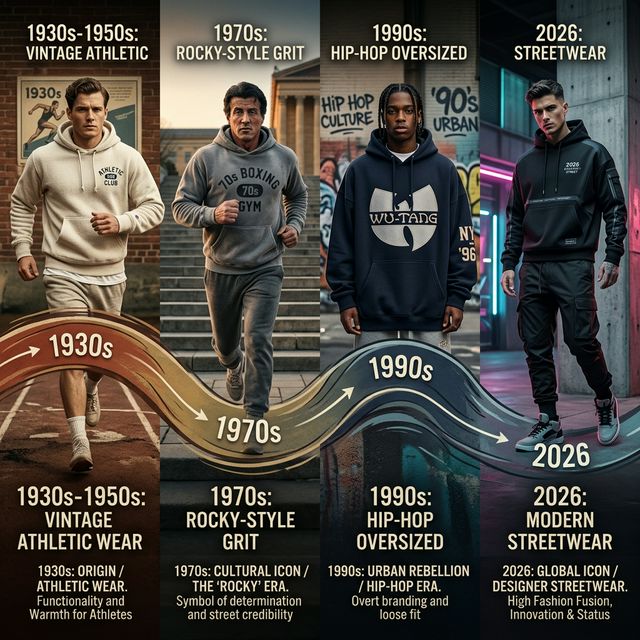
But the hoodie wasn’t always this ubiquitous. It started as a practical solution for cold workers in the 1930s, was adopted by athletes, transformed by hip-hop and skateboarding, politicized by media, and elevated by high fashion. This is the complete story of how a simple hooded sweatshirt became the most culturally significant piece of clothing in the modern world.
The 1930s: Champion Invents the First Hoodie
The hoodie’s origin story begins in Rochester, New York, in 1930, when the Knickerbocker Knitting Company (later renamed Champion) created the first hooded sweatshirt. The purpose was purely functional — keeping laborers warm in freezing upstate New York warehouses and frozen food lockers.
The original design was simple:
- Heavy-gauge cotton fleece for maximum insulation
- An attached hood to protect the head and neck from cold drafts
- A front kangaroo pocket for hand warming
- Ribbed cuffs and waistband to seal in warmth
There was nothing fashionable about it. The hoodie was industrial workwear — the kind of thing you threw on over your uniform when the temperature dropped. It stayed in this utilitarian lane for nearly two decades.
The 1950s-1960s: Athletes and Universities Adopt the Hoodie
Champion’s genius move came in the 1950s when they started supplying hooded sweatshirts to universities and athletic programs. Suddenly, the hoodie wasn’t just for warehouse workers — it was the warm-up layer for football players, track athletes, and boxers.
The association with athletics gave the hoodie its first identity beyond work: toughness, discipline, and physical excellence. When Rocky Balboa (played by Sylvester Stallone) ran up the Philadelphia Museum of Art steps in a gray hoodie in 1976, it cemented the hoodie as the uniform of the underdog fighter — the person working harder than everyone else.
Throughout the 1960s, universities began printing their logos on Champion hoodies, creating the “collegiate hoodie” aesthetic that remains massively popular today. Wearing your university’s name on a hoodie became a badge of identity — a tradition that shows no signs of fading.
The 1970s-1980s: Hip-Hop and Skateboarding Claim the Hoodie
The hoodie’s transformation from athleticwear to cultural symbol happened in the streets of New York City and the skate parks of California during the late ’70s and ’80s.
Hip-Hop and the Hoodie
In the Bronx and Harlem, the nascent hip-hop movement adopted the hoodie as part of its visual identity. Graffiti artists, b-boys, and MCs wore hoodies for practical reasons — warmth during late-night sessions, anonymity while tagging — but the hoodie quickly became inseparable from hip-hop culture itself.
Key moments:
- Break dancers wore hoodies as performancewear — the hood gave head protection during headspins and windmills
- DJs and producers wore hoodies in studios, creating an aesthetic of focused, late-night creative work
- Run-DMC, LL Cool J, and later Eminem made the hoodie a signature look that crossed racial and geographic boundaries
Skateboarding Culture
On the West Coast, skateboarders adopted the hoodie for similar reasons: protection, comfort, and identity. Brands like Stüssy, Thrasher, and Santa Cruz started producing graphic hoodies that became markers of subcultural belonging.
The skateboarding hoodie aesthetic — oversized, logo-heavy, intentionally worn and faded — would later become the foundation of streetwear fashion.
The 1990s-2000s: The Hoodie Becomes Political
As the hoodie spread from subcultures to mainstream fashion, it also became politically charged. The same garment that symbolized athletic discipline on a university campus symbolized perceived threat in other contexts.
During the 1990s and 2000s, hoodies became associated (often unfairly) with youth crime, gang culture, and anti-social behavior in media narratives. Shopping malls and some public spaces in the UK attempted to ban hoodies. The “hoodie ban” became a debated topic in government.
This politicization, however, only made the hoodie more powerful as a symbol of identity and resistance. The hoodie became the “uniform of the disenfranchised” — a garment that said “I exist, I’m here, and I don’t care about your dress code.”
The 2012 Trayvon Martin case brought the hoodie into the center of American civil rights discourse. The “Million Hoodie March” turned the garment into a symbol of solidarity and a statement about racial profiling. LeBron James, Dwyane Wade, and the entire Miami Heat posed in hoodies. The hashtag #HoodiesUp trended worldwide.
The 2010s: High Fashion Discovers the Hoodie
While the hoodie had been building cultural significance for decades, the fashion industry didn’t fully embrace it until the 2010s — when it happened explosively.
Kanye West and the Yeezy Effect
Kanye West’s Yeezy line (launched in 2015) placed the hoodie at the center of luxury streetwear. Oversized, earth-toned, and priced at $300+, Yeezy hoodies demonstrated that the garment could command designer prices. The fashion establishment took notice.
Vetements and the $800 Hoodie
Georgian designer Demna Gvasalia’s brand Vetements created hoodies that deconstructed and elevated the garment — oversized proportions, asymmetric hoods, and ironic branding. When Demna moved to Balenciaga, he brought the hoodie aesthetic with him, producing luxury hoodies that sold for $900-1,200.
The Athleisure Explosion
Simultaneously, the athleisure movement made wearing athletic-adjacent clothing acceptable in more settings. The hoodie benefited massively — it was no longer just for the gym or the couch. People wore hoodies to restaurants, offices (casual ones), airports, and dates.
Brands that bridged athletic and lifestyle — Nike, Adidas, Lululemon, Alo Yoga — built hoodie collections that became year-round staples rather than seasonal outerwear.
2020s and Beyond: The Hoodie Has Won
The COVID-19 pandemic (2020-2021) was the hoodie’s ultimate coronation moment. When the world went remote, the hoodie became professional attire by default. Zoom calls from the waist up meant business on top, hoodie on bottom — or, increasingly, hoodie on top too.
Key trends shaping the hoodie in 2025-2026:
- Heavyweight premium hoodies — Brands like Q-Finder, Carhartt WIP, and Los Angeles Apparel offer 12-14oz hoodies that feel like wearing a blanket
- Graphic storytelling — Hoodies as canvases for art, not just logos. Custom, artistic, and limited-edition designs are dominating
- Sustainability focus — Organic cotton, recycled polyester, and ethical production are increasingly important to buyers
- Gender-neutral sizing — The hoodie’s inherently unstructured fit makes it naturally inclusive across body types
- DIY customization — The rise of custom, hand-painted, and embroidered hoodies as a rejection of mass-produced fashion. (Learn how in our DIY hoodie customization guide)
Why the Hoodie Endures: The Psychology Behind the Garment
The hoodie’s dominance isn’t just a fashion trend — it’s psychological:
- Comfort and security — The hood creates a personal space, a cocoon. Pulling up the hood is an act of withdrawal from the world, creating a sense of safety
- Identity flexibility — The same hoodie can signal wealth (Balenciaga), rebellion (punk), athletic ambition (Champion), or creative identity (artist studio). No other garment is this adaptable
- Classless appeal — A plain black hoodie is the one garment that looks the same on a CEO and a college freshman. It’s the great equalizer
- Nostalgia — Almost everyone has a hoodie from a meaningful moment: a university, a band, a first job, a first relationship. Hoodies carry memories in ways suits and dresses can’t
The Hoodie’s Cultural Timeline
| Era | Primary Identity | Key Drivers |
|---|---|---|
| 1930s-1940s | Industrial workwear | Champion, cold-weather labor |
| 1950s-1960s | Athletic warm-up layer | Universities, boxing, Rocky |
| 1970s-1980s | Subcultural uniform | Hip-hop, skateboarding, graffiti |
| 1990s-2000s | Political symbol | Media narratives, youth identity |
| 2010s | Luxury/streetwear hybrid | Yeezy, Vetements, athleisure |
| 2020s | Universal wardrobe essential | Remote work, sustainability, DIY |
The Bottom Line
No other garment in history has traveled the path the hoodie has — from freezing warehouses to Paris Fashion Week, from boxing gyms to billion-dollar tech companies, from political protest to everyday comfort.
The hoodie endures because it doesn’t try to be anything specific. It’s whatever you need it to be. And that’s why, nearly 100 years after Champion stitched the first hood onto a sweatshirt, the hoodie isn’t just surviving — it’s more relevant than ever.
Explore Q-Finder’s hoodie collection — from graphic statement hoodies to premium blank canvases, printed in the USA on heavyweight blanks built to last. 🇺🇸
Frequently Asked Questions
Who invented the hoodie?
The hoodie was invented by Champion (originally the Knickerbocker Knitting Company) in Rochester, New York, around 1930. It was designed as functional workwear for laborers in cold warehouses and frozen food lockers, featuring heavy cotton fleece with an attached hood for warmth.
When did hoodies become fashionable?
Hoodies crossed from subcultural staple to mainstream fashion in the early 2010s, when luxury brands like Vetements and Kanye West’s Yeezy line placed them at the center of high fashion. However, hoodies had been culturally significant since the 1970s through hip-hop and skateboarding.
Why are designer hoodies so expensive?
Designer hoodies command premium prices due to brand prestige, limited production runs, premium materials (heavyweight organic cotton, custom dyes), and the cultural cachet of wearing a recognized label. A $900 Balenciaga hoodie uses better fabric than a $30 alternative, but much of the price reflects brand value, design innovation, and exclusivity.
