
T-Shirt Guides
How Custom T-Shirts Became a $10 Billion Industry
Apr
How Custom T-Shirts Became a $10 Billion Industry
In 1950, a custom t-shirt meant convincing a local screen printer to hand-pull your design for a minimum order of 500 pieces. In 2026, a 14-year-old with a laptop can design, produce, and sell a custom tee to a stranger in Oklahoma — and the shirt ships from a facility they’ve never visited, in a country they’ve never been to, while they’re asleep. That’s not just progress — that’s a $10 billion revolution.
The custom t-shirt industry has quietly become one of the most fascinating business stories of the digital age. From basement screen-printing operations to AI-generated designs shipped globally in 72 hours, this is the story of how a simple cotton shirt became a canvas for a multi-billion dollar economy.
The Origin Story: From Military Undershirts to Cultural Canvas
The 1940s-1950s: The T-Shirt Gets a Promotion
The t-shirt started as literal underwear — a military-issued undershirt worn beneath uniforms during World War II. When soldiers came home, they kept wearing them, and Hollywood noticed. Marlon Brando in A Streetcar Named Desire (1951) and James Dean in Rebel Without a Cause (1955) turned the plain white tee into a symbol of casual rebellion. For the first time, the t-shirt wasn’t something you wore under clothes — it was the clothes.
The 1960s: The First Custom Prints
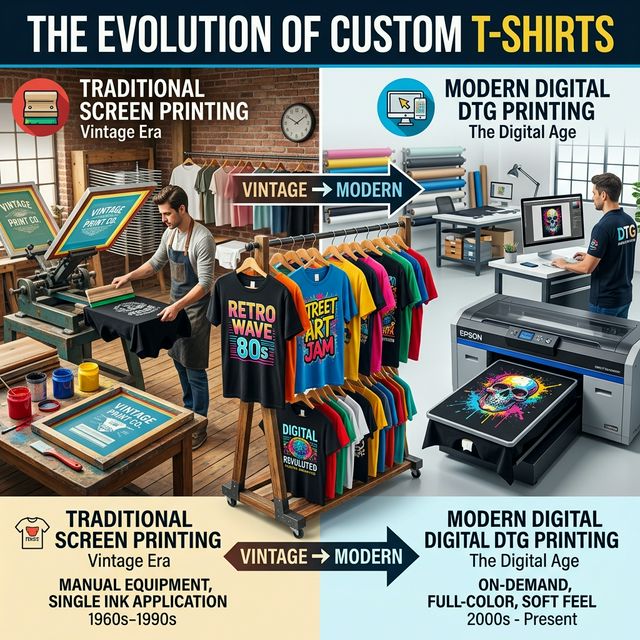
The political and cultural revolution of the 1960s gave birth to the graphic tee. Protest slogans, band logos, and anti-establishment art started showing up on t-shirts thanks to early screen-printing technology. The problem? Screen printing required physical screens — one for each color — which meant custom designs needed massive minimum orders to be cost-effective. Getting 50 custom shirts made was possible. Getting one? Economically absurd.
The 1970s-1980s: Band Tees and the Merch Economy
Rock bands discovered that a t-shirt bearing their logo was both a walking advertisement and a revenue stream. The band merch industry exploded, creating the blueprint for what would eventually become the print-on-demand economy: sell designs, not just products. By the late 1980s, screen-printed t-shirts were a $2 billion industry in the US alone.
The Technology Revolution: How Print Changed Everything
The 1990s: DTG Printing Is Born
The game-changing moment came in the 1990s with the invention of Direct-to-Garment (DTG) printing. Unlike screen printing, which requires physical stencils for each color, DTG works like an inkjet printer — spraying ink directly onto fabric with full-color, photo-quality precision. For the first time, printing one custom shirt was as cost-effective as printing 100.
This single innovation demolished the biggest barrier to custom t-shirt creation: the minimum order quantity. No more warehouses full of unsold inventory. No more gambling thousands of dollars on whether a design would sell. DTG made the one-off custom shirt economically viable, and the industry was never the same.
The 2000s: E-Commerce Meets Print
The launch of CafePress (1999) and later Zazzle (2005) created the first consumer-facing platforms where anyone could upload a design and sell it on a t-shirt without owning a printer, managing inventory, or shipping a single package. The print-on-demand model was born:
- Creator uploads a design
- Customer orders online
- Platform prints and ships the product
- Creator earns a royalty
This model turned millions of people who weren’t “in the t-shirt business” into t-shirt sellers. Artists, comedians, activists, social media creators — anyone with an idea and a JPEG could now monetize it.
The 2010s: Shopify, Etsy, and the Democratization of Everything
The 2010s brought the integration of print-on-demand services with major e-commerce platforms. Printful (2013), Teespring (2012, now Spring), and Printify (2015) connected directly with Shopify, Etsy, WooCommerce, and Amazon, allowing sellers to create professional-looking stores without touching a single shirt.
Key developments of this era:
- Merch by Amazon (2015) — Amazon’s own POD platform gave independent creators access to the world’s largest marketplace
- Shopify’s explosion — Custom apparel became the #1 product category for new Shopify stores
- Social media marketing — Instagram, Facebook ads, and later TikTok made it possible to target hyper-specific audiences with custom designs at minimal cost
The Numbers: How Big Is the Custom T-Shirt Industry?
| Metric | Value | Source Period |
|---|---|---|
| Global POD Market Size | $10-11 billion | 2024-2025 |
| Projected Market Size | $57-90 billion | By 2033-2035 |
| Annual Growth Rate (CAGR) | 25-26% | 2024-2035 |
| Custom T-Shirts as % of POD | ~40-45% | 2025 |
| Number of Active POD Sellers (est.) | 10+ million | 2025 |
| Average Setup Cost for New Seller | $0-50 | 2026 |
To put this in perspective: the custom t-shirt segment alone generates as much revenue annually as some entire fashion brands. And it’s growing at 25%+ per year.
The COVID Catalyst: 2020-2022
COVID-19 didn’t create the custom t-shirt boom — but it threw jet fuel on it. Here’s what happened:
- Online shopping exploded — E-commerce grew more in 2020 than in the previous 5 years combined
- People sought self-expression from home — Custom t-shirts became a way to express personality through screens (Zoom meetings, social media posts)
- Side hustle culture — Millions of laid-off or furloughed workers discovered they could start a t-shirt business with zero inventory and zero risk
- Community and cause shirts — Custom tees for BLM, healthcare worker appreciation, local business support, and pandemic humor flooded the market
The Modern Era: AI, Automation, and the Future (2023-2026)
The current chapter of the custom t-shirt story is being written by artificial intelligence and automation:
- AI Design Tools — Platforms like Midjourney, DALL-E, and specialized POD design tools allow sellers to generate hundreds of unique designs in minutes. A design that would have cost $200 from a freelance artist in 2020 can now be created for free in 30 seconds
- DTF (Direct-to-Film) Printing — The latest evolution in print technology. DTF transfers produce vibrant, durable prints on virtually any fabric color with incredible detail. It’s faster, cheaper, and more versatile than DTG
- Global Fulfillment Networks — Major POD providers now have print facilities across North America, Europe, and Asia. A customer in London and a customer in Los Angeles can order the same design and both receive it in 3-5 days from local facilities
- Sustainability Focus — The POD model is increasingly positioned as an eco-friendly alternative to fast fashion. Zero overproduction, zero warehouse waste, and production only when there’s actual demand
5 Reasons Custom T-Shirts Are a $10 Billion Industry
- Zero Entry Barrier — You don’t need money, inventory, or expertise to start selling. T-shirts, hoodies, and mugs can all be produced on-demand through platforms that handle everything from production to shipping
- The Longing for Personalization — Mass-produced fashion is losing to personalized expression. People want shirts that say something about them — their humor, their identity, their niche interests, their dog’s breed
- Niche is King — The internet lets you sell to hyper-specific audiences. “Funny T-Shirts for Left-Handed Guitar Players Who Own Cats” is a real market — and it’s profitable because the competition is near zero
- Social Media as Free Advertising — A great custom tee is inherently sharable. People photograph and post their shirts, creating organic marketing that costs the seller nothing
- Technology Keeps Getting Better — Every year, the print quality improves, the costs decrease, and the speed accelerates. The gap between custom-printed and mass-manufactured quality has effectively closed
What’s Next: 2027 and Beyond
Industry analysts predict the custom t-shirt and POD market will continue its explosive trajectory. Key trends to watch:
- On-demand stores in physical retail — Imagine walking into a mall kiosk, designing a shirt on a screen, and walking out with it 15 minutes later. This technology already exists in pilot programs
- AR/VR try-on — Virtual fitting rooms that show you exactly how a custom design looks on your body before you order
- Sustainability as standard — Water-based inks, organic cotton blanks, and carbon-neutral shipping are becoming the baseline, not the premium option
- Creator economy integration — TikTok, YouTube, and Instagram creators selling merchandise isn’t a side gig anymore — it’s the core business model for millions of content creators
The custom t-shirt industry’s journey from $0 to $10 billion is one of the great democratization stories of modern business. It proves that when technology removes barriers, creativity fills the space. And right now, there’s more space — and more opportunity — than ever.
👉 Explore Custom T-Shirt Designs at Q-Finder
Frequently Asked Questions
How big is the custom t-shirt industry?
The global print-on-demand market, with custom t-shirts as its largest segment, is valued at approximately $10-11 billion as of 2025. Industry analysts project it will grow to $57-90 billion by the mid-2030s, driven by AI design tools, improved printing technology, and increasing consumer demand for personalized products.
How did custom t-shirts become so popular?
Three key innovations drove the explosion: Direct-to-Garment (DTG) printing in the 1990s eliminated minimum order requirements, e-commerce platforms like Shopify and Etsy in the 2010s made selling accessible to anyone, and the COVID-19 pandemic in 2020 accelerated both online shopping and side-hustle entrepreneurship. Together, these forces turned custom t-shirts from a niche hobby into a multi-billion dollar industry.
Can you still make money selling custom t-shirts in 2026?
Yes — though the market is more competitive than ever, the demand is also at an all-time high. Success in 2026 requires finding a specific niche audience, using AI tools to create unique designs efficiently, and leveraging social media marketing (especially TikTok and Instagram) to reach targeted customers. The sellers who thrive are those who understand their audience deeply and create designs that speak to specific identities, interests, or humor.
