
T-Shirt Guides
How to Tie Dye a T-Shirt: A Beginner’s Guide With 5 Easy Patterns (+ Halloween Ideas)
Oct
How to Tie Dye a T-Shirt: A Beginner’s Guide With 5 Easy Patterns

Tie-dye is having one of its biggest comebacks in years — and if you typed “tie and dye t shirt,” you mean tie-dye: the resist-dyeing technique where you fold, twist, and bind fabric before adding color. With Halloween nine days away, it’s also the perfect weekend craft project. Here’s everything a beginner needs: supplies, the prep that makes colors stick, five classic patterns, and three Halloween ideas you can finish before the 31st.
Why Tie Dye Is Trending Again
Tie-dye searches are surging. Roughly a million Americans search for tie-dye every month — about 20% more than last year — and one analysis put tie-dye searches at 3.4 million in just four weeks earlier this year (Free Spirited Clothing data, reported September 2026). Rainbow and multi-color designs still rule: about 22.5% of tie-dye purchases, followed by blue (~17%) and green (~16%).
The look has evolved, though. Alongside the classic psychedelic spiral, muted palettes — pastels, earth tones, washed-out designs — are gaining ground for everyday outfits. Good news for beginners: your first shirt doesn’t have to scream rainbow to look good.
The timing is interesting too. Tie-dye searches usually peak in summer and dip toward year-end — but the query is climbing right now, and the craft blogs explain why: Halloween tie-dye. Jack-o’-lantern spirals, candy corn patterns, and reverse bleach tie dye on black tees are everywhere this month, pulling a “summer” craft back into the spotlight in late October.
What You’ll Need
A basic tie-dye kit covers most of this — here’s what each item does:
| Supply | What to get | Why it matters |
|---|---|---|
| Plain white tee | 100% cotton, pre-washed, no fabric softener | Cotton absorbs fiber-reactive dye; synthetics dye poorly |
| Fabric dye | Fiber-reactive dye kit with pre-measured bottles | Kits often include soda ash; food coloring fades fast |
| Soda ash | Washing soda — 1 cup per gallon of water | Raises fabric pH so dye bonds permanently; don’t skip |
| Bindings | Rubber bands or string | Tight binds stay white and draw the pattern |
| Tools | Squeeze bottles, gloves, zip bags, surface cover, rack | Dye stains skin for days — gloves aren’t optional |
How to Tie Dye a T-Shirt: Step by Step
The process is the same for every pattern; only the folding changes.
- Prep the shirt. Pre-wash, then soak in soda ash solution for 15–30 minutes. Wring until damp, not dripping.
- Fold and bind your pattern. (Five beginner patterns below.)
- Apply the dye. Put on gloves, mix dye per package directions, and apply generously to the front of the bound bundle — then flip and do the back. Undersaturated spots are the #1 cause of faded results.
- Let it set. Seal the shirt in a zip bag or plastic wrap to keep it damp. Six to eight hours minimum; overnight gives deeper, longer-lasting color.
- Rinse and wash. Rinse under cold water until it runs clear, remove the bands, and keep rinsing. Machine-wash the shirt separately in cold water with mild detergent (no softener) for the first two or three washes.
5 Beginner Tie-Dye Patterns
The rule of thumb: tighter binding = more white lines; looser binding = more blended color.
1. Spiral (Swirl)
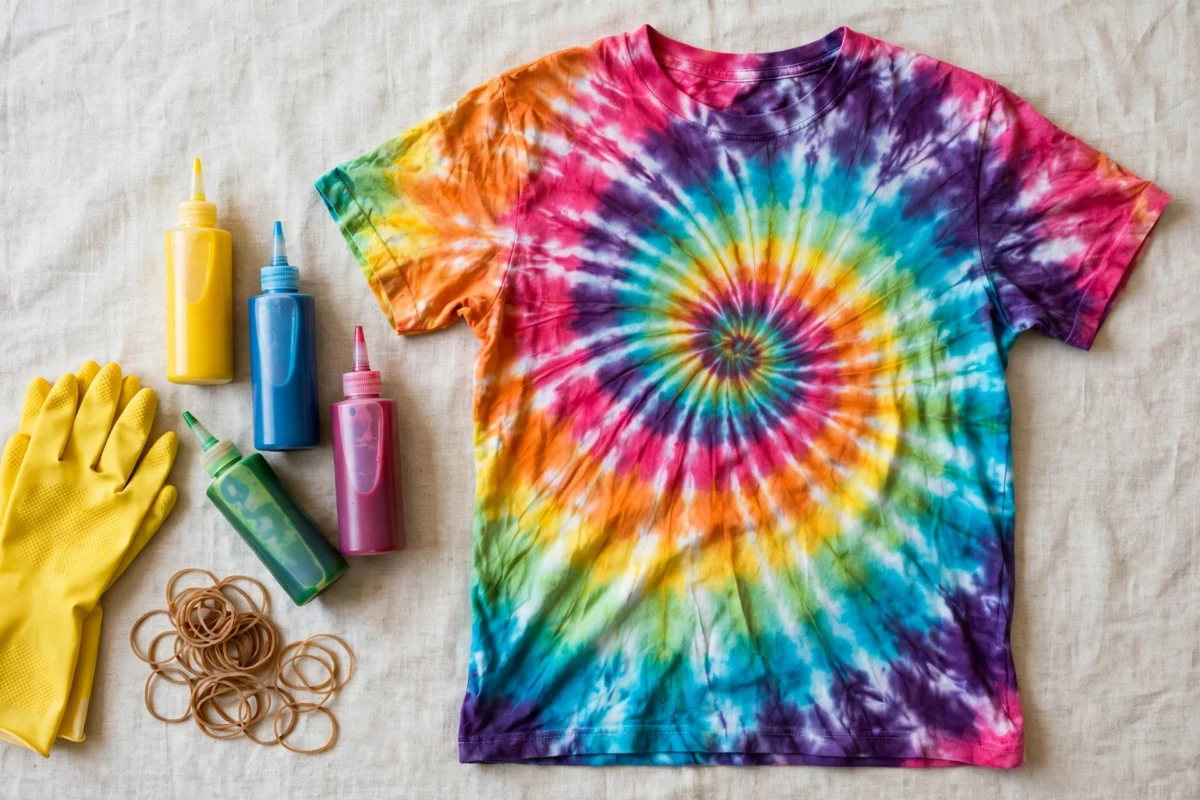
The icon. Pinch the shirt’s center and twist clockwise until it coils into a flat disc like a cinnamon roll. Secure with 3–4 rubber bands crisscrossed over the center to form pie wedges, then apply a different color in each wedge — rainbow order gives the classic look.
2. Crumple (Scrunch / Nebula)
The easiest — controlled chaos. Scrunch the damp shirt into a tight, flat mound, wrap rubber bands around it, and apply dye on all sides. A mottled, marbled effect with zero skill required.
3. Bullseye
Pinch a point where you want the center, pull it up into a cone, and wrap rubber bands at intervals along the cone. Apply alternating colors to each section for concentric rings.
4. Stripes
Fold the shirt accordion-style (back and forth like a paper fan), band it every 1–2 inches, then apply dye in alternating sections. Horizontal folds give horizontal stripes.
5. Sunburst
Pinch several small sections and pull each up into a little cone, securing each with a couple of rubber bands. Dye each cone a different color — great with just two or three dyes.
Quick Pattern Picker
| Pattern | Difficulty | Vibe |
|---|---|---|
| Spiral | Medium | The classic rainbow look |
| Crumple | Easiest | Mottled, artsy, no-skill-required |
| Bullseye | Easy | Bold concentric rings |
| Stripes | Easy | Clean, modern lines |
| Sunburst | Medium | Scattered pops of color |
3 Halloween Tie-Dye Ideas (Try Them This Week)
| Project | How to make it |
|---|---|
| Jack-o’-lantern tee | Dye an orange-and-yellow spiral (or solid orange crumple). Once fully dry, stencil a jack-o’-lantern face on with black fabric paint. Dye one day, paint the next. |
| Candy corn tee | Fold the shirt in half, draw a half candy-corn with a washable marker, then accordion-fold along the outline. Dye the tip yellow, the middle orange, and the rest black — let the black set 24 hours. |
| Reverse tie dye (bleach) | Start with a black 100% cotton tee. Shield shapes (ghosts, bats, spiderwebs) with stencils, apply bleach carefully in a ventilated area wearing gloves, then neutralize with a hydrogen peroxide rinse. |
Tips for Vibrant, Wash-Fast Color
- Don’t skip the soda ash soak. It’s the difference between colors that pop for years and colors that fade in a month.
- Saturate the dye. Timid application is the most common beginner mistake — flood each section, front and back.
- Watch color mixing. Adjacent colors blend where they meet; keep light colors next to dark ones so the result doesn’t turn muddy.
- Rinse until the water runs clear, then wash the shirt alone in cold water for the first two or three washes.
Prefer to Buy Instead of DIY?
Fair point: consistent, vibrant results take a couple of tries. If you love the look but not the mess, pre-dyed tie-dye tees in rainbow, pastel, and earth-tone palettes are widely available — and many print shops now offer tie-dye-style prints with crisp graphics real dye can’t produce. Either way, check the fabric: 100% cotton (or high-cotton blends) is what holds color.
FAQ
Is it “tie-dye” or “tie and dye”? Both mean the same thing — “tie and dye” is just how many people type the search. The standard spelling is “tie-dye”: tie the fabric, then dye it.
Does tie dye wash out? With 100% cotton, a soda ash pre-soak, and an overnight set, it stays vibrant for years. Skip those steps and it fades fast.
Can I tie dye with food coloring? As a fun first try: soak the shirt in a 1:1 vinegar-water solution for an hour, apply food coloring, and set it in a bag 8–24 hours. But it’s nowhere near as bright or wash-fast as real fiber-reactive dye.
Can you tie dye polyester? You can, but polyester barely absorbs fiber-reactive dye — expect pale results. Use 100% cotton or cotton-heavy blends for vibrant color.
The Bottom Line
Tie-dye endures because beginners get great results on the first try — the folding does the designing for you. Start with the crumple if you’re nervous, try the spiral next, and don’t skip the soda ash. Making one this week? A jack-o’-lantern spiral is perfectly timed.
