
Design Meanings, T-Shirt Guides
Vintage Hawaiian Shirt Patterns: A Collector’s Guide to Rare Prints
Apr
The Art of the Vintage Hawaiian Shirt: A Collector’s Deep Dive
Before it was a fashion statement, the Hawaiian shirt was a work of art. The original aloha shirts from the 1930s through 1960s weren’t mass-produced novelty items — they were hand-designed, often hand-printed, and crafted from premium rayon crepe that draped like liquid gold. Today, vintage Hawaiian shirt collecting is a serious hobby, with rare pieces selling for thousands of dollars.
Whether you’re a seasoned collector hunting for grails or a curious fashion lover who wants to understand why some Hawaiian shirts cost more than a used car, this guide covers the patterns, eras, and details that separate museum-worthy aloha shirts from tourist-shop knockoffs.
The Golden Era: 1930s-1950s Hawaiian Shirt Patterns
1930s: The Birth of Aloha Wear
The first Hawaiian shirts emerged when local Honolulu tailors like Ellery Chun began cutting shirts from Japanese kimono fabric. These earliest pieces feature small, repeating patterns — often Japanese-influenced geometrics mixed with Hawaiian botanical motifs. They’re extremely rare; authentic 1930s pieces are museum territory.
Key identifiers: small-scale prints, Japanese-style florals, cotton or silk fabric, hand-stitched construction, and no brand labels (these were custom-made, not mass-produced).
1940s: The War Era and the Rise of Rayon
World War II changed everything. American servicemen stationed in Hawaii discovered aloha shirts and brought the style home. This decade saw the transition from cotton to rayon crepe — the fabric that defines the classic Hawaiian shirt aesthetic.
1940s patterns are characterized by large-scale, dramatic designs: bold hibiscus flowers, towering palm trees, erupting volcanoes, and sailing canoes. The colors are deep and saturated — burgundy, forest green, golden yellow, and ocean blue. Brands like Kamehameha, Aloha Shirts Mfg. Co., and Watumull’s were the pioneers.
1950s: The Golden Age
This is the decade collectors obsess over. The 1950s represent the artistic peak of Hawaiian shirt design, with patterns that are genuinely stunning works of textile art:
- Border prints — designs concentrated along the hem, creating a visual “frame” when worn
- Scenic panoramics — entire landscapes wrapping around the shirt depicting Hawaiian scenes
- Asian-fusion motifs — dragons, koi fish, bamboo, and cherry blossoms on Hawaiian silhouettes
- Abstract designs — modernist interpretations influenced by mid-century art movements
The holy grails of this era include shirts by Alfred Shaheen (the undisputed king of Hawaiian shirt design), Sun Surf, Duke Kahanamoku, and Surf Line Hawaii. A mint-condition 1950s Alfred Shaheen can fetch $1,000-5,000+ at auction. Explore Hawaiian shirt designs at Q-Finder.
Iconic Vintage Print Categories
Tropical Flora Prints
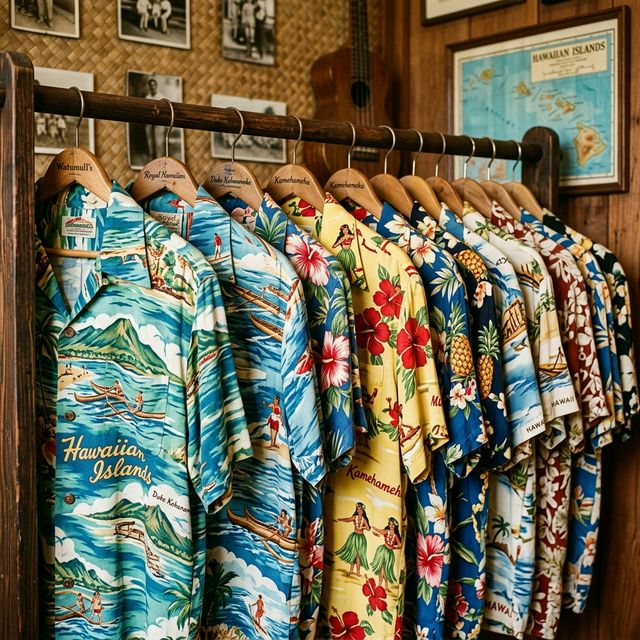
The most recognizable category. Hibiscus, plumeria, bird of paradise, anthurium, and orchids rendered in bold, painterly strokes. Vintage flora prints differ from modern ones in their artistic quality — original designs were often painted by hand before being transferred to fabric. The flowers look dimensional, almost sculptural, rather than flat and digitized.
Scenic Island Prints
Complete Hawaiian landscapes told in fabric: Diamond Head at sunset, outrigger canoes on turquoise water, thatched-roof villages nestled among palm groves. These panoramic designs wrap around the entire shirt, creating a wearable postcard. The best scenic prints tell a story — you can see fishermen working, surfers riding waves, and hula dancers performing.
Tapa and Tribal Prints
Inspired by traditional Polynesian tapa cloth (bark cloth) patterns. These geometric designs feature repeating motifs drawn from Hawaiian, Samoan, and Tongan cultural art — petroglyphs, sea turtles, tiki figures, and abstract ocean waves. Tapa prints are usually rendered in earth tones: brown, rust, cream, and black.
Asian-Influenced Prints
Hawaii’s multicultural population is reflected in Hawaiian shirt design. Japanese, Chinese, and Filipino artistic traditions blend with Hawaiian aesthetics: dragons among palm trees, koi fish swimming through hibiscus, bamboo forests with diamond head in the background. These fusion prints are among the most sought-after by collectors.
Nautical and Surf Prints
Anchors, sailing ships, surfboards, fishing scenes, and marine life. The Duke Kahanamoku brand specialized in these designs, featuring the legendary surfer’s name alongside ocean-themed artwork. Vintage nautical prints capture the romance of mid-century Pacific maritime culture.
How to Identify Authentic Vintage Hawaiian Shirts
Fabric: The First Test
- Rayon crepe: the definitive vintage fabric. It drapes heavily, has a subtle texture, and a matte/semi-sheen finish
- Silk: rarer, used in premium pieces. Smooth, lightweight, with a natural luster
- Cotton: used in 1930s and some 1960s+ pieces. Lighter, more structured than rayon
- Red flag: any shirt labeled “polyester” is post-1970s at best, novelty at worst
Construction Details
- Coconut shell buttons: the hallmark of authentic Hawaiian craftsmanship
- Loop collar: a fabric loop that holds the collar flat when unbuttoned (a 1950s innovation)
- Pattern matching: high-quality vintage shirts align the print across seams — a sign of careful construction
- Pocket alignment: the chest pocket print matches the body print seamlessly
- Single-needle stitching: indicates hand-guided construction, not mass production
Labels and Tags
- Pre-1971: labels say “Made in Hawaii” (before Hawaii was commonly abbreviated as “HI”)
- 1950s-60s labels: typically woven, not printed, with brand name and “Honolulu” or “Hawaii”
- “Aloha Republic”: a 1970s+ brand — not vintage
- Country of origin: authentic vintage pieces were made in Hawaii or Japan. “Made in China” = modern reproduction
Most Valuable Vintage Hawaiian Shirt Brands
| Brand | Era | Price Range (Vintage) | Known For |
|---|---|---|---|
| Alfred Shaheen | 1940s-1980s | $200-$5,000+ | Hand-painted designs, metallic inks |
| Kamehameha | 1930s-1960s | $300-$3,000+ | Earliest commercial aloha brand |
| Duke Kahanamoku | 1930s-1960s | $500-$4,000+ | Surf culture, nautical prints |
| Sun Surf (repro) | 1990s-present | $100-$400 | Museum-quality reproductions |
| Shaheen’s of Honolulu | 1950s-1960s | $200-$2,000 | Scenic prints, border designs |
| Surf Line Hawaii | 1960s-1970s | $100-$1,500 | Bold surf art, psychedelic patterns |
Starting a Vintage Hawaiian Shirt Collection
For Beginners
- Start with Sun Surf reproductions — they faithfully recreate classic patterns using authentic rayon at accessible prices ($100-200)
- Shop estate sales and thrift stores in Hawaii and California — original pieces still surface
- Learn to identify fabrics by touch — rayon crepe has a distinctive weight and drape you’ll recognize with practice
- Budget $50-300 per shirt for everyday-wearable vintage pieces from the 1960s-70s
For Serious Collectors
- Follow specialty dealers on Instagram and vintage marketplaces
- Attend the Bailey’s Antiques & Aloha Shirts in Honolulu — the world’s largest vintage aloha shirt dealer
- Focus on a specific era, brand, or print type to build a cohesive collection
- Document provenance — a shirt’s history adds value
- Store properly: acid-free tissue, padded hangers, climate-controlled environment
Modern Brands That Honor Vintage Tradition
If authentic vintage is out of budget, these brands capture the spirit with modern quality:
- Sun Surf (Toyo Enterprise): the gold standard for reproductions, using original-era printing techniques
- Reyn Spooner: Hawaii’s oldest continuously operating aloha brand, known for their reverse-print style
- Avanti: hand-printed silk shirts recreating classic 1940s-50s patterns
- Q-Finder: modern Hawaiian shirts with authentic camp-collar construction and premium fabrics — browse the collection here
👉 Shop Hawaiian Shirts at Q-Finder
Frequently Asked Questions
How can I tell if a Hawaiian shirt is truly vintage?
Check three things: fabric (rayon crepe or silk, never polyester), construction details (coconut buttons, pattern-matched pockets, loop collar), and the label (woven, not printed, with “Made in Hawaii” or a known vintage brand name). Authentic pre-1970s shirts also have a distinctive drape and weight that modern reproductions struggle to replicate. When in doubt, consult a specialist dealer.
Why are vintage Hawaiian shirts so expensive?
Genuine vintage aloha shirts are hand-designed works of textile art on premium fabrics — not mass-produced novelty items. The supply is finite and shrinking (they’re 60-90 years old), demand from collectors and fashion enthusiasts is growing, and the printing techniques used in the 1940s-50s produced colors and details that modern digital printing still can’t perfectly match. It’s art that you can wear.
What’s the most expensive Hawaiian shirt ever sold?
A 1950s Alfred Shaheen “Pali” scenic print reportedly sold for over $10,000 at a specialized vintage auction. Pre-war (1930s-40s) shirts by Kamehameha and Duke Kahanamoku have sold in the $3,000-8,000 range. The most valuable shirts combine rarity (limited production), condition (no stains, tears, or fading), provenance (documented ownership history), and iconic design.
